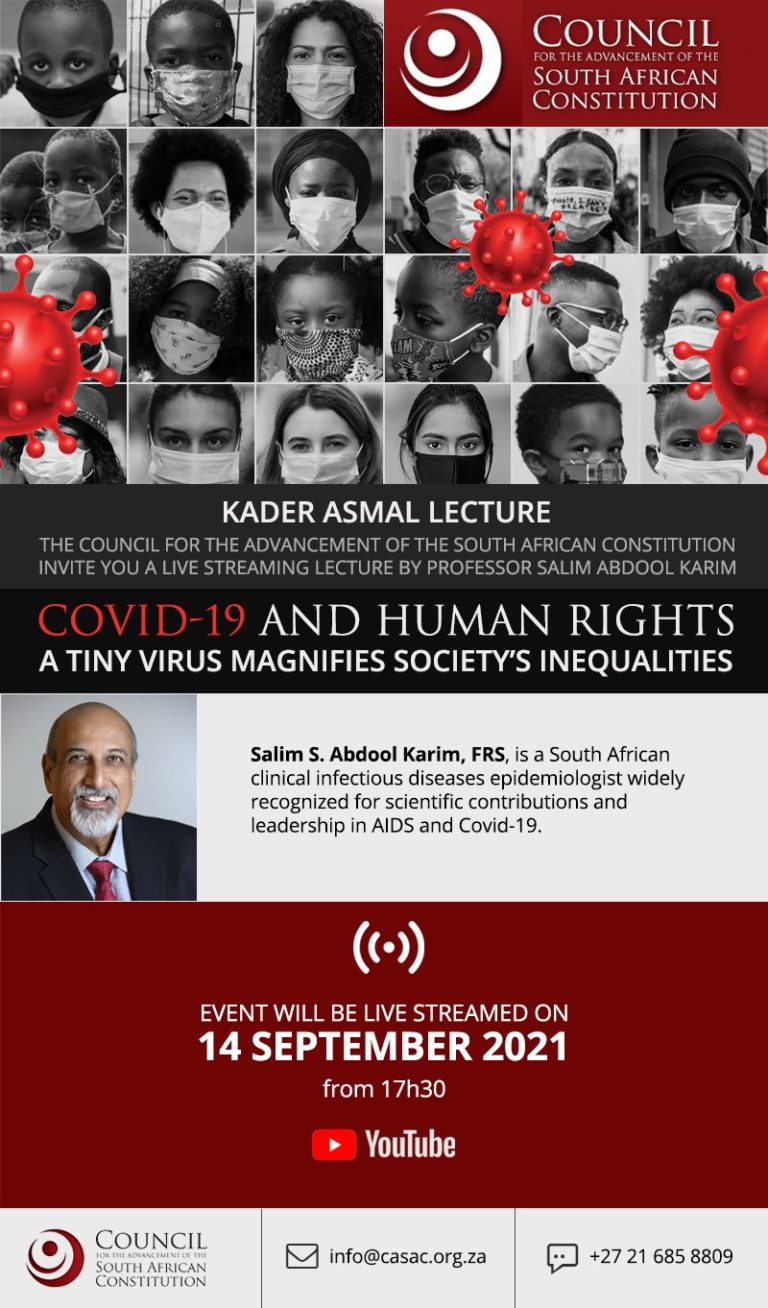
COVID-19 and human rights: A tiny virus magnifies society’s inequities
A very good evening to all, it is a great pleasure and an honour for me to be here with you. Not least because I am a big fan of Redi Tlhabi. I have followed the amazing work of CASAC, I initially got the email inviting me to speak, I wondered was Lawson contacting me because he wanted some guidance on COVID in relation to cricket tours and very quickly I realized no, it was about the Kader Asmal Lecture, so indeed I am honoured, I am honoured that you invited me, I am honoured to be here with you today.
Her Excellency the Ambassador of Ireland, Chairman of ENS Michael Katz, members of the executive of CASAC and one and all.
What I want to do in the course of the next 45 minutes or so, I’m going to tell you about a tiny virus that we can’t even see with the naked eye has served as a magnifying glass on society’s inequities. And what I hope to do, I hope to in the course of this lecture give you a perspective of the challenges we face and the way this virus has given us new more opportunities to understand the challenges, it has exacerbated those challenges and ultimately, I’d like to look at the way forward.
Let me start by paying tribute to Prof Kader Asmal, he hails from Stanger quite near where I live in Kwa-Zulu Natal. He studied education initially, he was a teacher, then went on to study law and he became involved while he was student in the ANC’s defiance campaign but a turning point, an important part of what changed in him, that gave him a new spark, he referred to it was the meeting with Nkosi Albert Luthuli that firmed up that spark in him to serve the cause of humanity both in South Africa and then also in Ireland. He left South Africa and went to Trinity College and served there for many years. I think he was best described as a rebel who became a leader. I have to tell you when I first met him, it was quite an experience because when you walked into a room where Kader Asmal is, you sort of know he is there, nobody needs to tell it to you. He has a presence, the best description I can actually say is larger than life.
He consumes everyone around him, he envelops you. When he returned to South Africa, he joined the University of the Western Cape as a Professor of Human Rights, he was part of the ANC’s constitutional committee, he was part of the negotiations – you’ve already heard. But the part that I have spent some time understanding is many years ago back in 2008 was why he decided to leave Parliament.
His descriptions around the challenges of the way in which Parliament was choosing to act in particularly in relation to disbanding the Scorpions, sadly he was diagnosed with cancer and eventually passed on in 2011 as a result of a heart attack. So, if Kader Asmal was with us today, on this decennial anniversary of his passing, what would he say about country now? Unfortunately, I can’t channel him, I don’t what he would say but let me take a shot. Let me take a guess, that possibly he may have said, that I foresaw that disbanding the Scorpions was a critical first step in removing the corruption fighters and appointing the alleged enablers of corruption, the ignorers of corruption, particularly in key positions often with Parliament’s support.
I have given you some examples of some of the candidates I am referring to in relation to testimony at the Zondo Commission and I’ve thrown in just for good measure a get out of jail free card and I will leave it to your imagination why it is next to Arthur Fraser. I can say it in summary that Kader Asmal stood boldly against the tide of corruption, and we need many, many more Kader Asmals in our midst to take that stand and to put us back on that path that will lead us to the greatness we could be as a nation.
I am going to talk about the state of the pandemic, I will talk about the COVID response, I’ll talk about the benefits of the evidence-based approach we took in our country, then I will talk about the inequities, before talking about what lies ahead.
This is a diagram of the COVID-19 pandemic in South Africa starting from the time we had our first patient back on 5 March 2019. We were at that stage, the epidemic was doubling every two days, we were in the midst of a rapidly growing epidemic.
Fortunately, because of early action that was taken, we slowed the spread of the virus and so eventually we had our first wave in July of last year. Since then, we’ve had two more waves as you can see. When you look at each of those three waves in the yellow line you can see the first wave driven by the D6 variant, you can see the second wave which was driven by the beta variant and now we are in the midst of the third wave driven by the delta variant, we are at the tail end, it’s not over yet but it will be done in the next few days.
When we reflect on all of those three waves, we are sometimes so caught up in our own, we feel sorry for ourselves sometimes, we feel like we’re being held back this pandemic is not allowing us to do the things we love and enjoy and in South Africa we forget, we lose sight that the reality is that the whole world is dealing with COVID-19, the world. There are over 200 million cases, there are almost 5million deaths, this is a pandemic that is impacting everybody, and we are feeling it everywhere across the world. It’s taking its toll in deaths on the left-hand side, I am giving you a diagram of the world, showing you excess deaths.
You can see excess deaths across the world, several countries including South Africa are shaded in the darker colour, globally there are about 3.34fold excess deaths than reported COVID-19 deaths. In South Africa, the excess deaths are about 2.29fold what the reported deaths are. So, it is a global challenge that we have, that we only know about a third or so of all the deaths from COVID-19. So, let’s look at the response, and look at a human rights-based approach, or is it just that this response is just a pretext for authoritarian control as it has sometimes been pointed out.
Let me take you back to March last year – this diagram shows you the epidemic and the cases occurring in countries across the world at the point at which we had to make a difficult decision about what to do about this pandemic. Now, there’s no-one in South Africa who is an expert on corona viruses, that must be first stated, they are pretty obscure. We know they cause the common cold, so most of us who have been involved in infectious diseases really come from HIV, TB and other viruses and so we had to benefit from what was known elsewhere in world.
And what were the pictures we were all seeing? We were seeing pictures of the overwhelmed hospitals in Italy; we were seeing the mass burials in New York City, and it was frightening. We knew so little, and it is hard to tell somebody, we know so little about this virus back in March of last year. When you are faced with that level of uncertainty, it means you have to make difficult decisions, and you have to make them by bravely facing the problems and you have to act decisively. This is not a time to second-guess yourself, you have to make difficult decisions timeously and you have to act decisively.
Now we did have a previous epidemic, call it a pandemic although it was not officially declared in HIV and we chose not to act decisively, we chose in fact to go with denialism and prevarication, fortunately we didn’t have that problem in COVID-19. In fact, other countries did have that problem in COVID-19, I’ll give you the example of the US where they had similarly had – oh the virus is going to disappear in the summer. We’ve had that sort of denialism even in COVID-19, fortunately not in South Africa. So, we had really difficult decisions made timeously.
To give you an example of important it is, Neill Ferguson, who is one of the advisors to the UK government did an analysis in which he showed the UK delayed in instituting its lockdown and then he worked out that if the UK had imposed its lockdown one week earlier, it would have halved the number of deaths they had in April, that is how important time is during this pandemic.
The fact that we were able to act in such a decisive way was really important. Across the board it wasn’t exactly the same way in other countries, in fact in this analysis that was undertaken there are about 80 countries that across the world that respect for human rights has been dented by this pandemic. The governments have used this pandemic to silence critics, scapegoat minorities and using COVID emergency measures to harass dissidents in some countries. I have given you some examples in Algeria and Israel, of how the COVID response, there’s a fine line between using it to deal with the pandemic and using it to deal with opposition.
When we think about that, when we think about human rights and the response it is useful to go back in history briefly and deal with the three eras which are probably easiest to describe. In the first era which we through the bubonic plague, when we were dealing with early cholera, the priority was about saving lives. In the absence of enough scientific evidence, we had to take action and the people leading the response at the time set human rights aside and dealt with the public health response and that era we live through, now we but previous generations lived through were quite harsh.
The actions that were taken to contain many of these diseases were extremely harsh but in HIV we came to a new world. We came to understand that the public health response is one that can deal with human rights but often they were in conflict and we saw that in all of the marches and partly because HIV impacted on vulnerable individuals, individuals who were marginalized and discriminated against by society, gay men, drug users and so we had this continual conflict between the public health response we need to mount against this epidemic and the human rights.
We’ve moved on, in the course of the HIV epidemic we have progressively moved on, we have tried to find a way in which we can integrate and deal with the human rights issue as part and parcel of the public health response, the two go together. Jonathan Mann said it better, he said that protecting human rights is an essential part of the public health response to HIV. He gave us a whole new way of looking at HIV, Jonathan Mann was a great, great hero. He led the programme on AIDS, that was the predecessor to UNAIDS, and he set the response on a path that saw human rights and public health coming together.
Now I have to tell you that when you see the source of all of this material, you’ll see it says S Abdool Karim published in press in Constitutional Court Review. I can assure you I don’t write any articles and don’t publish in the Constitutional Court Review, there just happens to be another S Abdool Karim in my family who wrote this piece, I am borrowing liberally courtesy of family connections. So, are limitations of freedoms for COVID-19 justifiable? Well, Article 25 of the Universal Declaration of Human Rights makes it clear that everyone has the right to a standard of living adequate for health, for COVID-19 the right to health, the right to life was counterposed with limiting certain other rights including the right of association, the freedom of speech, bodily integrity and so on.
The first challenge that came in that way that government was balancing these different rights was taken to the Constitutional Court by the Hola Bon Renaissance Foundation, the Constitutional Court dismissed that application. But there are two key elements we continually keep at the fore, as we weigh up the various rights and how we balance them.
The first is, I refer to as externalities that fundamentally the impact of each person’s actions influence the risk of others that there is potential for harm to other people from each person’s individual actions and that’s critically important because something that you do is not just something that impacts you, it impacts other people. Just think about it, somebody who is not following the rules and is exposing them gets infected, they will be spreading the virus for several days even before they know they have the virus and they will be exposing people at home, they will expose people they sit with in the taxi, in the bus, they will be exposing people at work, they are now the source of this virus. And just think about it, this virus started off with coming from one bat in China through an intermediate host into a human probably just in one person and from that one person over 200 million people infected.
So, when we talk about the externalities, they are massive, they are huge, especially think about it, a person who is exposing others particularly say a 70- or 80-year-old that has a very risk of dying, that is a very high externality. And the second is, is there evidence to justify the path that has been taken, do we have scientific data that can guide us, that can give us justification for the limitation of rights. I did a literature search on the 22nd of March when this whole idea of a lockdown was being bandied and the President was going to make an announcement the next day and we were going to try to figure out what to do and I can tell you, that in the entire medical literature on that day there were only three mentions of lockdown, one was this Chinese booklet that came actually from Wuhan, it was a booklet that dealt with lockdown that they instituted in Wuhan to control the virus and of course they did so very successfully with the lockdown.
The second was in Mexico for swine flu and the third was a lockdown in Cote d’Ivore for Ebola and that’s it. Lockdown is not actually in our terminology in our textbooks, I am one of the authors of one of the prime textbooks used in public health in our medical schools – there is no word lockdown anywhere in that textbook. It is not part of our vocabulary, but it was used very effectively during the Spanish flu, lockdown or what it was referred to then, it was called crowding control, they closed schools, they banned gatherings and so on, this was what we knew at the time.
But over the course of the last year, it was impressive that the Minister called a group of us together, we were over 50 scientists on that call and it was the morning that the President was going to make the announcement and he said to all of us, I need you to give me advice, I understand we don’t know a lot but what do we know, what can we draw from other diseases? I need to get that advice. And so, the first year of this pandemic when I was chair and co-chair of the Ministerial Advisory Committee we provided 119 advisories, they are all on the SA Coronavirus website, and I did a detailed analysis of all 119 and I was very pleased to see that 81% of our advisories were fully implemented.
There were just four advisories that were not implemented at all, and that just gives you some idea that although we might not think it and some people might believe otherwise, the reality is that the South African response was guided by scientific advice. So, what was that advice and how did it benefit our response. Well, the first was that we benefited enormously from the delay that we had in our first wave, we gained about 8weeks. Why was that important? Because it enabled us to build field hospitals, it enabled us to organize oxygen, it enabled us to do a whole range of things. We mobilized 70 000 health care workers to go to house to house in our most vulnerable communities and to educate people and to offer testing for COVID.
You can just imagine, just think for a moment that the Cape Town ICC, if anybody had asked me in February, can you convert the Cape Town Convention Centre into 800 bed hospital with oxygen at every bed and 27 bed ICU, I would have said, yes, yes it can be done it will take about 7-8 years and you have to understand this there is probably going to have to be a lot kickback involved in all the contracts over those years and I was just amazed, I was totally amazed. In six weeks it was done, six weeks – I am looking at the pictures – Keith Cloete is talking to me from Cape Town ICC showing me pictures – it is done, he ready to take the first patient in six weeks.
I tell you South Africans are amazing in what they can do when they put their minds to it. I was bowled over. We knew back in April last year that we didn’t have enough oxygen, that we were going to run short of oxygen, we had to bring the four oxygen manufacturing companies together, had to get Competition Commission’s approval to do that and we had to sit them down and work out how we are going to make sure we have enough oxygen and will you believe it in all three waves, we’ve never run out of oxygen. We didn’t run out of oxygen because we planned, took the steps that it required to make sure, we had a plan.
We even had a published 8-stage plan which I presented to the whole country in April last year. So, that early proactive response was quite important and for me, COVID-19 has set a new bar in terms of communication. So, I studied my first epidemic back in the 1980s, 1984 to be exact. We had an epidemic of measles; I was asked by a reported and I gave a comment and the Minister picked up on that comment and I got a call from the Minister’s office – the Minister at that time was Rina Venter – and she asked that Prof Coovadia and I come to Parliament to brief her about this epidemic.
So it was the first time, we are scientists – we are normally in the backroom, that’s where we belong – but in COVID it has given us a new transparency, a new level of information flow that every day there is press release telling you how many tests were done, how many cases, how many deaths – it often even runs as the first item on the news – that’s how much of transparency we had. We even have organisations like CASAC going on television talking about COVID-19, we have family meetings on a Sunday after dinner we get together for family meeting to discuss COVID-19 to hear the President.
We have also had our downs, the military response, in South Africa we mobilized 70 000 troops in the level 5 lockdown and we saw the very unfortunate events on Collins Khoza when I think now as to our wholly inadequate response to the insurrection, to the looting that occurred in Gauteng and Kwa-Zulu Natal where the government only mobilized 2500 troops and I am wondering is this an over-reaction to what happened before. We have got to find a different way to do this. We cannot have a situation where our military are making people do push-ups on the street, we have to find a way where we protect people’s dignity as deal with a pandemic.
And of course, the corruption, the virus creates the opportunities for corruption and the looters were there to take their pound of flesh. We saw it in the way PPE contracts were done, and just so that we don’t believe that this is the only country that has corruption – I saw this interesting Guardian article where about 1/5 of all the UK contracts were flagged for possible corruption. So, we are not sitting on this boat alone.
And for me one of the big challenges about how health care services were impacted, in these articles we published in science and the Lancet – we showed how during especially the level 5 lockdown – reduced patient attendance, it impacted HIV testing, it impacted TB testing in so many different ways. And it wasn’t that the clinics and hospitals were closed it was that people were apprehensive, they didn’t want to be where COVID patients were, so we found that we were being challenged, routine elective surgery was cancelled, so much of health care was impacted as a result.
How does this tiny virus magnify some of society’s inequities? Well, the first point is, it is more than a viral infection if we just look, and I have chosen to highlight 5 major global damaging impacts of SARS-CoV-2, the first is that it increased poverty, the world bank estimates that in its most recent report there are an extra 150 million people who are in extreme poverty as a result of the pandemic. The World Food programme recent report shows that 161 million more people are now hungry, they are now food insecure and we’ve created in the course of this pandemic, we’ve created yet another epidemic which is called the info-demic where people conjure up that Mr Gates has got nothing better to do that put microchips in vaccines because he wants to sit and see where you’re walking into.
We have just seen the way in which fake news and conspiracy theories have spouted and one of my deepest concerns is that around the political instability that we have seen as a result of COVID-19 that it has presented to many societies a whole new challenge about government exerts control over the population. I have chosen to show a picture from France because there were so many different protests, but this highlighted for me the real challenges of trying to implement measures like vaccine mandates and the repercussions as a result.
That political instability is going to be even worse because we are sitting on a powder keg in Africa because we have such low levels of vaccinations and when the fourth wave hits we are going to see two worlds, we are going to see the world where there’s been vaccinated, they have no problems or they have minimal impacts on their health care services – in Africa we will see scores of people dying because they are not vaccinated and need health care.
I think that is going to lead to whole set of new challenges we will have to deal with. And then we will have to deal with the disparities, whether it is race or gender or data access and let me touch on each of those very quickly. In this diagram you can see on the left-hand side in the US how much higher the death rates are in black Americans compared to white Americans and on the right-hand side in the UK we can see the disproportionate contributions of deaths in blacks in the UK.
In our own country, in South Africa the data that comes from Cape Town from hospitalization shows that blacks have a 70% higher mortality rate, it is actually not a mortality rate, it is what is called a case-fatality rate that it is a proportion of admissions who died and coloureds it’s increased by 60% but look at Santiago on the right-hand side, what a strong relationship there is between mortality or death and socio-economic status, it is a challenge across the world. So, it is not just an Apartheid thing it is the way in which race and socio-economic status impact health care. And of course, we have to deal with many of the challenges of gender inequality and gender inequity particularly during the lockdown the gender-based violence and not only that but in other things many subtle impacts where women have to differentially deal with the burden.
For example, among those who have lost jobs women have more often lost jobs than men in the course of this pandemic. So, there are many ways in which gender inequity plays itself out, but nowhere has it been clearer than in this pandemic as to the impact of the digital divide. In that digital access has determined who can continue schooling at home, who can continue working remotely, globally it’s estimated that about 60% of the world, about 4.5billion people, have internet access but in Sub-Saharan Africa amongst students it is estimated about 90% do not have a computer at home and 82% lack internet access.
It is estimated in South Africa about 21million don’t have access to the internet. So, it really makes a huge difference when you are forced to limit your movement, your access to the internet and computers. And let me deal with the last aspect of this inequity in my talk, before I go onto what lies next. And that’s vaccine Apartheid, which I deem equal to actual Apartheid – it’s a crime against humanity – when you look at this picture and you see how low the vaccine coverage is in Africa, it is somewhere in the region of 4% – whereas most of the other continents have even passed 50% vaccine coverage and this is all in the midst of the vaccine actually being manufactured and finished right here in South Africa and 32 million doses of those vaccines were sent to Europe and none to here.
It just shows you the challenges we are dealing with, that in countries that have secured large numbers of doses that in the US there are millions of doses expiring as a result, they are wasting doses because there aren’t arms to put them in. And, it just highlights for me the challenge that we face, the way in which vaccine fascism has led to this challenge that we face and it is not that there are not enough, there are enough vaccines for all countries if the rich were willing to share – you cannot have a situation where half of the world supply is reserved for 15% of its population – this diagram that comes from the Economist is just amazing for me – when you start looking at countries who have surpluses and countries that have shortages and you will understand that actually this is a created problem for us.
And this inequity is not only between countries it is also within countries. I thought I would use one of the most successful countries in the world in dealing this pandemic, New Zealand. New Zealand is currently on a really roll in terms of vaccine roll-out, they were slow to start but they are really getting on, but even in New Zealand the Māori population and the Pacific people are way behind in their vaccine coverage compared to the other populations. So, this not a problem only between countries it even exists within countries. Why is it that we are dealing with this challenge?
It is because we have chosen to distribute vaccines at a global level using market forces and political influence. Let me just quickly walk you through this, there are 5 different ways in which countries secured vaccines, the first group to get vaccines were the countries that made their own vaccines, there were six countries – the US, the UK, Germany, China and Russia – they made their own vaccines so they got the vaccines first – they were the first to get doses because their governments paid for those vaccines to be made.
The next group are those who secured advanced market commitments, so in other words these were countries who went different companies making vaccines, they don’t know if the vaccine is going to work, this is long before we knew vaccines were working, they went out and bought out vaccines before we could even know that they work. Now, South Africa was not in a position to do that, to put out that kind of cash but rich countries did so. So much so, that a country like Canada bought nine doses of vaccine for every one of its citizens.
So, you can imagine the surpluses they are sitting with and the stockpiles that they have in Canada. If you are going to buy as one country nine times the number of vaccines that you need it means that somebody else is not getting the vaccine that they need. The third way in which countries got their doses was through vaccine diplomacy, and here we saw how countries like the United Arab Emirates, Seychelles and several other countries secured vaccines very early and in Africa two countries did, Morocco and Egypt, they were vaccinating back in February and March, and they did so because they were able to get as part of a political linkage with other countries, in this case with China.
So, they secured vaccines from China even before those vaccines were formally approved. The next two ways in which people got vaccines is through purchasing, you went to a company, and you bought vaccines as we did in South Africa from Pfizer and J&J and then finally Covax. The WHO, Garvey and Seppi set up Covax as mechanism to create equity but one was not able to achieve that goal.
So, I thought I would reflect on how our vaccine distribution system at a global level is broken and I’d like to quote from Kader Asmal, where he talks about human dignity, individually and collectively cannot be determined by the pricing mechanisms of the market – we simply cannot have vaccines as a commodity being bought and sold – that mechanism of distributing vaccines is simply not fit for purpose, the pandemic vaccines have to be treated as a global public good.
I want to add one new dimension to this vaccine inequity because the outbreak of delta variant in Israel is causing great concern, Israel was one of the countries that was first to vaccinate back in January, they were also one of the first to release their restrictions, and in dealing with that they are now facing quite a severe delta variant epidemic and they have argued that it’s because there is waning immunity in other words because people got people got vaccinated in January, now in August and September that immunity has now gone too low and so now they’re getting infected.
The data that is available to support it, I have to tell you is not convincing, and so these are the data that come from Israel. If you look at left-hand side it just shows you in the different age groups that it’s true that those who got vaccinated in January and February are more likely to get symptomatic infection but what really matters for us is will they get severe infection and the answer to that is no, it didn’t matter if you were vaccinated in January or February, it didn’t matter you had similarly high level of protection, over 90% against severe disease.
And so, in reality these vaccines work, and they work still no matter when you took them. We are going to really deal with this problem now because the rich countries are going to want to give everyone who has been vaccinated, a third booster dose and then a fourth dose, so when are those vaccines going to get to us here in Africa because the rich countries are going to keep buying them. The WHO has called for a moratorium on booster vaccine dosing to stop the use of these doses in rich countries because poor countries need it.
So, let me end off with what lies ahead – I have already shared in many different fora we can expect to get a fourth wave somewhere in the latter part of this year – late December 2021 or early January 2022, somewhere around there – I don’t know if there’s going to be a fourth wave this is just a best guess in terms of what have seen so far. We can expect more waves, we can expect vaccine mandates, we can expect more variants, and we can expect to continue to use our public health measures.
Now we have a genuine challenge with vaccines, so in any new technology you will get the innovators, the innovators is a small group, they will get vaccinated by hook or by crook, it doesn’t even matter if there are vaccines available, they will find a way and they will get a vaccine. Then you got your early adopters, those are the ones who are waiting in queue from early in the morning to get their vaccines.
Then you get to the early majority, the pragmatists, so they will get around to it and they don’t have a problem, they will do it it’s just maybe tomorrow? And then you this late majority, who are the conservatists, they need more incentives, they need mandates and so on and then you got the laggards, the anti-vaxxers who will never take a vaccine. So, should vaccinations be mandatory? And I would say we should preferably not have a universal mandate, that would simply reinforce mistrust and actually foster a whole underground industry, that mandatory vaccines must be implemented they will be important in certain settings – take health care – imagine a health care worker gets infected and starts spreading it all of the patients who are very vulnerable that is a very high risk situation, so we require vaccine mandates in health care services and several other places, like public transport and so on.
The legal framework for this already exists in the Occupational Health and Safety Act, and even in the US, Indiana University imposed a vaccine mandate for its staff and students, and I was very impressed with what the District Court Judge said when the students and staff challenged it, it went all the way up the Supreme Court.
The Supreme Court chose not to hear it because it didn’t feel that it had any prospect of success. It is widely being implemented across the world. Let me touch on the issue of variants because you can’t really talk about what lies ahead without dealing the variants. We’ve already seen alpha variant, beta variant, delta variant and we’ve seen how these variants and I have just chosen to give you the example of India, Brazil and South Africa each of them had dealt with their first wave but look at the way in which the variants have changed the second wave.
India dealt with a horrific second wave due to the delta variant. In Brazil they were dealing with the gamma variant and here in South Africa we had both – we had beta and now we even have delta variant and we’ve seen how delta variant in particular has changed the game, it is more transmissible, there’s an increased risk of hospitalization, you get more re-infections and some people have argued that perhaps the virus can’t get better than delta – when you deal with viruses and mutations you will be amazed at how the mutations can cause changes in the virus but delta has really set our entire world back.
And in particular in South-East Asia, which is one part of the world that wasn’t actually badly hit by the first and second waves, but delta has changed all of that. Just look at the way the deaths have risen in the red line and when I saw this picture of the graves that were being built in Indonesia, it just shakes you. How do we solve this problem of variants? There are many different ways, one of the ways I have found most exciting is the whole concept of a pan-corona virus approach where we look at what are the constant parts of all the corona viruses, there are seven that infect humans and we make vaccines based on that, so that as the virus mutates the conserved parts can’t change because then that will compromise the virus.
So, this is very interesting, Walter Reed has already started human trials of this, there are several papers now that have shown there are anti-bodies that protect against the whole of the Sarbecovirus family – Sarbecovirus family is all of the variants even the viruses that are in the bats. I anticipate that we will go to a future that will have probably a pan-corona virus vaccine and part of that future is that we going to have to live combination prevention.
The vaccines are not a silver bullet, it’s not that you vaccinate, and you don’t have to worry about your other prevention measures we going to have use our entire prevention toolbox. And let met end off with what is for me a key lesson from HIV for COVID-19 and that is the importance of mutual inter-dependence and leadership and I quote from UNAIDS – the AIDS Movement demonstrates that with a shared vision, shared responsibility and through global solidarity and leadership of people living with HIV, affected communities and individual action we can change the course of history and we’ve done that with HIV.
HIV was a death sentence; now we can get treatment no matter how poor you are, and we have done so through the Global Fund, through UNAIDS, through PEPFAR, we tried to do it through Covax but not very successfully. That mutual interdependence is critical because everything, each one of us impacts every one of us.
I would like to end off by quoting from none other than Kader Asmal, because he gave us that same lesson and it comes directly from him and I quote, because he deals with the issue of mutual interdependence and leadership when he said: “We must reclaim the struggle’s morally just cause that people come before the person” – the mutual interdependence “the people come before the person, that action speaks louder than words and that we will always treasure the noble honour of being servant leaders rather than leaders who serve themselves”.
Thank you very much.
Professor Salim S. Abdool Karim is a South African clinical infectious diseases epidemiologist who is widely recognised for his research contributions in HIV prevention and treatment. He is Director of the Centre for the AIDS Program of Research in South Africa (CAPRISA) and CAPRISA Professor of Global Health at Columbia University.
The lecture is made possible through the support of ENSAfrica and the Irish Embassy in Pretoria.
You can watch the full lecture below.
Slides used during lecture PDF – Kader Asmal Lecture – 14th Sept